San Francisco, CA – In February 2026, after much suggesting from people I met familiar with my work with MemoryVideo.com and DigitalImmortality.com, I finally watched digital immortality themed episodes of Pantheon and Black Mirror (San Junipero). I already watched The Matrix growing up. In Netflix’s Pantheon, human consciousness is scanned, compressed, and uploaded into servers, where it continues to evolve. In The Matrix, the mind is separable from the body, inhabiting a simulated world indistinguishable from reality. Episodes of Black Mirror imagine digital afterlives where personality persists long after death.
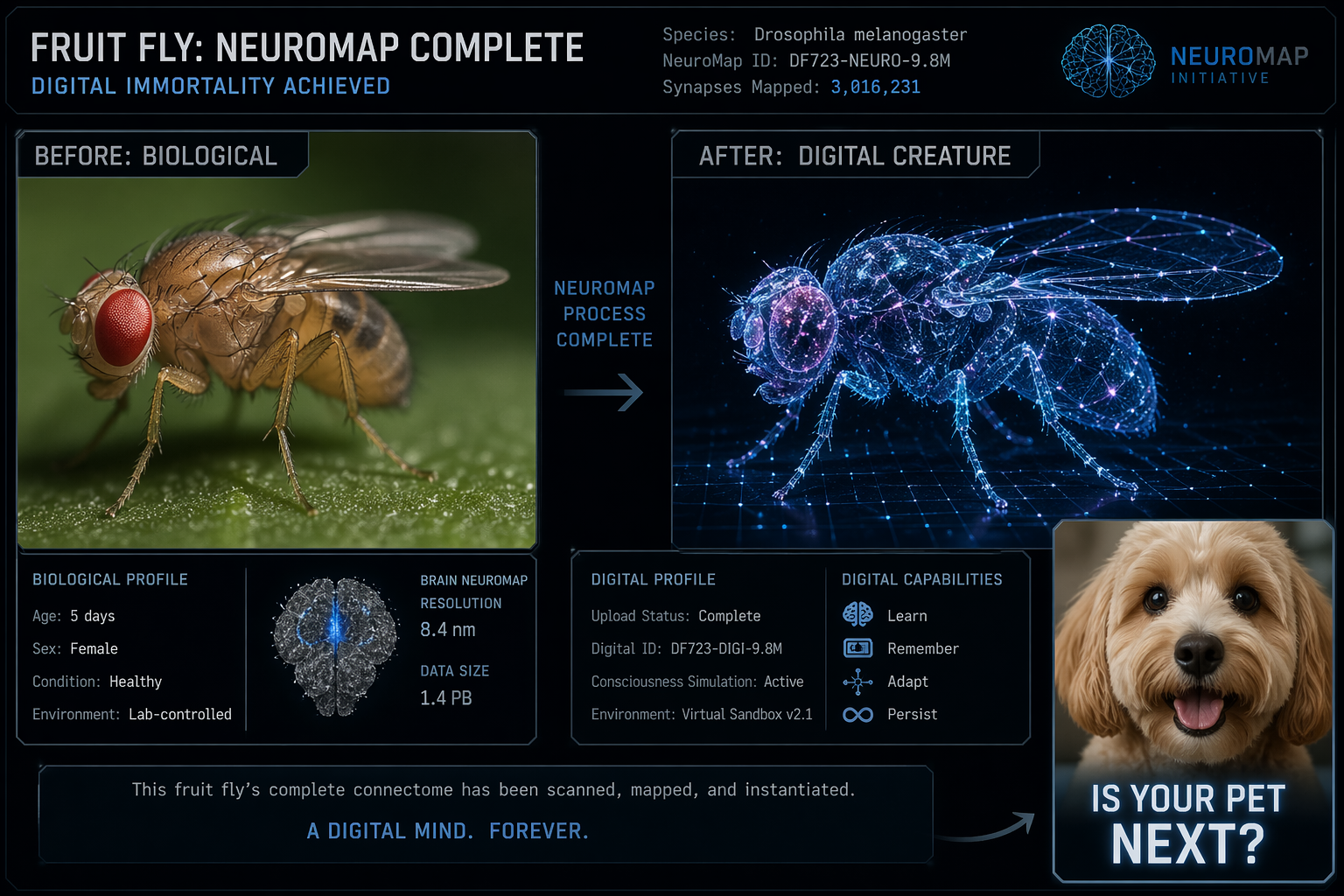
So, I was delighted in March 2026 to see news that a start-up, interestingly named Eon Systems (the last three letters of Pantheon*) in San Francisco succeeded in mapping the brain of a fruit fly and digitally running the simulation. I hoped to see a “live cam” of our digital creature doing what a fruit fly would do, much like an aquarium computer screensaver or a live look at the adorable Punch the Japanese monkey, popular on social media. This was hailed as a breakthrough in artificial intelligence, not by pre-programming training data and using probabilities, but simulating how a brain actually works on a limited basis. Intelligence emerges from the organization of neurons themselves.
*Eon (or aeon) generally represents a divine, eternal power or a celestial being that emanates from a supreme deity, rather than just a vast length of time.
“Eon Systems PBC, demonstrating what we believe is the world’s first embodiment of a whole-brain emulation that produces multiple behaviors,” wrote the company’s co-founder Alex Wissner-Gross, on X.
While this digital fly according to cybernews.com, “This fly doesn’t get hungry in the biological sense, nor does it learn from its mistakes. It lacks the hormones, internal states, and plasticity that make a living fly so unpredictable.”
“We only implement a small subset of sensory inputs and model only a handful of behaviors,” said the scientists.
“Internal state, plasticity, learning, and hormonal changes are largely missing. Biological flies do not respond to the same sensory input the same way in all contexts.”
If the fruit fly represents a beginning, it is a modest one. The fruit fly’s brain, containing roughly 140,000 neurons, has now been mapped in full detail.
A human brain contains approximately 86 billion neurons, orders of magnitude beyond current mapping capabilities. Even scaling from a fly to a mouse introduces complexities that remain unresolved: neurochemistry, plasticity, and the dynamic processes that allow brains to learn and adapt over time.
Still, a rough progression is beginning to take shape.
In the near term, researchers are likely to focus on increasingly complex animals—organisms whose brains can be mapped, simulated, and validated against real-world behavior. Each step upward is less about scale alone and more about fidelity: capturing not just structure, but function.
Beyond that lies a different category of application, one that may arrive sooner than human uploading: the digital preservation of animals.
Why Pets May Come First
The idea is straightforward, if unsettling. Pets occupy a unique space:
- neurologically simpler than humans, yet
- emotionally significant.
They are, in a sense, ideal candidates for early forms of digital immortality.
Rather than requiring a complete neural scan, such systems could combine behavioral data, recorded interactions, and partial biological modeling to create something approximating a pet’s personality. Over time, these representations could be embodied in software, virtual environments, or even physical machines (a robot replica of your beloved pet).
The result would not be a perfect reconstruction. But it might be close enough.
BBC News: I brought my husband back for his funeral as a hologram
Something I’d want for myself and I wish I had a memory video of friends who passed away so this could be an option. I recently read a BBC article about a woman who created a hologram of her late husband (Bill) for his funeral. He wanted a “super wake” event, and...
Digital Immortality and the Race to Preserve Cultures
San Francisco - I was at the 2025 Big Game (football) in Palo Alto, Cal vs Stanford, and during halftime I had an interesting conversation while in a long line for refreshments with “Evelyne”, a Stanford graduate student from Francophone West Africa who studied...
Start up Uare.ai raises $10 million
Image from Uare.ai websiteDigital immortality start up Uare AI and founder Robert LoCascio raised $10.3 million in funding led by Mayfield and Boldstart Ventures, according to Techcrunch. There is growing interest in the use of personal AI in digital immortality with...
How Latin America’s Day of the Dead Inspires a Global Digital Immortality Movement
Photo: Kyle talks with Brazilian professionals Mara Remor (international business and translator) and Rodrigo Alves, founder of SingulAI.Every November 2nd, across Latin America, millions gather to honor their ancestors. Cemeteries bloom with marigolds, candles...
Coco and the Second Death: How Technology Could Defeat Forgetting
San Francisco, CA — In 2017, Pixar’s Coco captivated audiences worldwide with its heart-warming music, vibrant imagery, and moving portrayal of Mexico’s Día de los Muertos traditions. Yet beneath its colorful surface, the film offered one of the most profound...
Echoes of Forever: How Fiction Imagined Digital Immortality Before Technology
San Francisco, CA — Long before the term “digital immortality” entered Silicon Valley boardrooms or startup pitch decks, writers, filmmakers, and myth-makers had already been experimenting with the idea in the safe laboratory of fiction. Across fantasy, science...
From GANs to Grandparents: How AI Avatars Are Preserving Family Wisdom for Generations
What if your great-grandchildren could sit down and talk to you—years after you're gone? It may sound like science fiction, but this is quickly becoming reality. Thanks to advances in AI—specifically a technology called Generative Adversarial Networks (GANs)—we’re...
Elon Musk: Digital Immortality, Digital Twins, and the Road to Mind Uploading
In an age where artificial intelligence is rewriting the rules of life and death, few public figures have contributed more provocatively to the conversation about digital immortality than Elon Musk. The tech billionaire, known for building rockets, electric cars, and...